
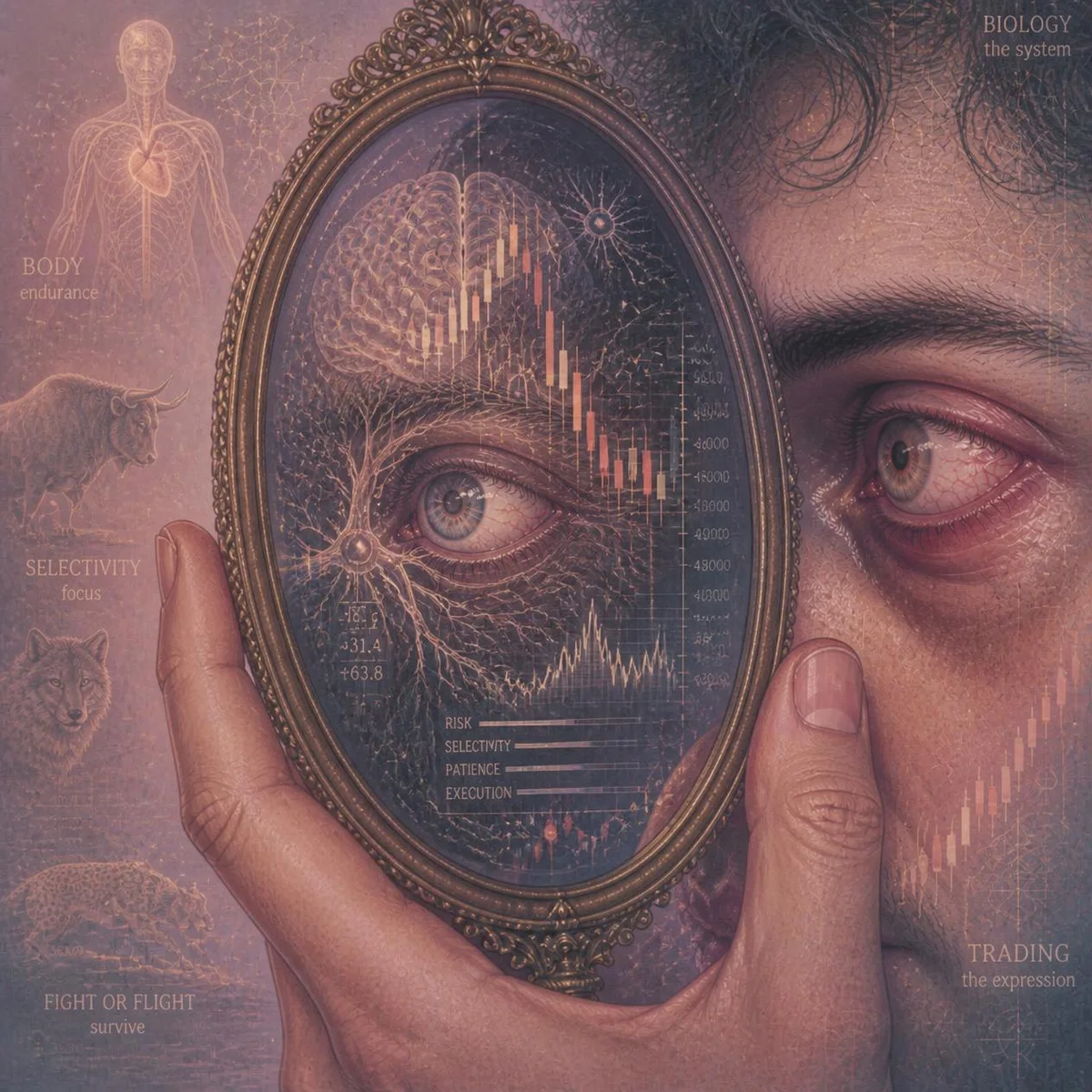
Discipline was never a thought. It's something your body either has or doesn't.
Most traders treat discipline like a setting you switch on. Read the rules, repeat the rules, promise yourself you'll follow the rules. Then the open hits, price rips through your level, and every promise you made the night before disappears in about four seconds.
That's not because you're weak or because you didn't want it badly enough. It's because you tried to install discipline in the wrong place.
Discipline is an emotion, and emotions live in the body. Until you understand that, you'll keep trying to think your way out of problems your thinking never created.
The Body Moves First
Spend enough time watching your own mind, not living inside it but actually watching it, and you'll notice two things.
The first is that thoughts almost never overlap. They arrive one at a time, single file.
The second is the one that changed how I trade. Before a thought shows up, something happens in the body. A tightening, a charge, a small vibration. That impulse comes first, and the thought is the mind translating it into words after the fact. The body sends the signal and the mind writes the caption.
This isn't only something I felt in reflection. Neuroscientist Antonio Damasio built an entire theory around it, the somatic marker hypothesis, which argues that bodily signals steer our decisions before conscious reasoning catches up.[1][2] John Coates, a former Wall Street trader who became a neuroscientist, measured it directly on a London trading floor and found traders' hormone levels shifting with their profits and with market volatility.[3][4] The body keeps its own book, and it trades it whether you agree or not.
So if belief and emotion are stored in the body, then the voice in your head that says "be patient, wait for your setup" is a narrator talking over a system it doesn't control. You aren't losing an argument with yourself. You're arguing with the wrong department.
The Market Is a Mirror
Here's the part people don't like hearing.
Whatever you lack physically, you'll lack in the market. If you don't have strength, endurance, dexterity, or flexibility in your body, you won't have them in your execution either. You can't hold a trade through heat you can't hold in your own body. You can't adapt to a market that changes character mid-session if your nervous system only knows one gear.
The market isn't some separate force happening to you. It reflects you back at yourself, tick by tick. When you look at your P&L, you're looking at a picture of your nervous system.
The market is you.
Endurance: The Plank and the Setup
Hold a plank. Somewhere around the ninety-second mark a voice starts negotiating. That's enough. You've proven the point. Just drop your knees for a second.
Now sit at your desk during the chop before your setup forms. Candles pushing up, pulling back, faking breaks both ways. Listen closely and you'll hear the same voice. Just get in. It's going to go. You'll miss it.
That's not a coincidence and it's not a metaphor. It's the same circuitry. The system that wants out of the plank is the one that wants into a trade that isn't there.
Which means endurance is a trading skill, and you can train it away from the screen. Every time you hold the plank past the point your body begs to quit, you're training the same muscle that has to sit still through noise. You have to last long enough in the market to actually get your sample, and you have to last long enough inside each session to actually see your setup. Neither happens if you tap out early.
Selectivity: The Hunter's Dilemma
Now picture an open field thousands of years ago. Several gazelles, a couple of lions, everything moving at once. Which do you chase? Which do you avoid? Which one gets you killed?
That's the wiring you bring to the 6:30 open. The market throws a constant flood of "opportunity" at you, and your ancient hardware reacts to every piece of it as if it's food or a threat. Every move looks like a gazelle getting away.
That framework kept our ancestors alive. In today's markets, it's outdated, and it will empty your account.
Selectivity means knowing when to attack and when not to. It's the hardest skill in trading, because you can't learn it from a checklist. It lives at the same level as the instinct you're trying to override, so that's the level you have to train it at. Meditate on it. Sit with the urge to chase until you can watch it rise without obeying it.
And notice the order. You can't be selective if you haven't endured long enough to see enough opportunities. Endurance builds the sample, and selectivity is what you do with it. First you learn to stay, then you learn to choose.
Where Did It Actually Hurt?
Take a losing trade that stung. Maybe it stopped you out by a tick before running exactly where you said it would. Now ask yourself honestly where you got hurt.
Did the market reach through the screen and bite you? Did a candle leave a mark?
No. All of that pain is psychological, and psychological pain doesn't float around in the air. It lands in the body and it stays there. The tight chest on the next entry, the hesitation, the revenge click. That's the last loss still sitting in you, looking for a way out.
Your body is a storage vessel. It remembers every loss, every forced trade, every time you broke your own rules. That's why trading isn't just an intellectual game. It's an emotional one, the same as life. You can't separate the two, because the thing doing the trading is the same thing doing the living.
Structure Is How You Speak to Your Biology
If biology comes first and thinking comes second, then something follows that most traders get backwards.
We try to push ourselves toward our goals with the voice in our heads, through motivation, self-talk, and pressure. It fails because thinking is downstream. You can't steer a river by yelling at the bottom of it.
This is what structure and routine are really for. They aren't productivity hacks. They're the language your biology understands. A fixed routine gives the body fewer things to react to, and every variable you leave unfixed is one more thing your already-reactive system has to deal with in real time.
The more unfixed variables you carry into a session, the harder trading gets. When did you wake up, what did you eat, did you train, what's your max loss, what's your setup, when do you walk away? If those are still open questions when the bell rings, you're asking a nervous system in fight-or-flight to make decisions it should never have been handed.
So decide it all before the session, and let the structure do the thinking so your body only has to execute.
One Shot, or the Same Shot Forever?
Underneath all of this is a question most traders never answer honestly.
Are you trying to hit one trade and be done? Or are you trying to become consistently profitable, which means taking the same good shot again and again for years?
I know my answer. I'm not trying to touch a billion once. I want to make a billion and then do it again, over and over and over.
That answer changes everything, because the goal stops being a trade. The goal becomes a nervous system that can produce the same disciplined behavior on command, on a good day or a bad day, rested or tired, up or down. You can't think your way into that. You have to build it into your body.
Animal First, Then Human
Here's where it all lands for me.
We are animals before we are human. The chasing, the fear, the scanning for threats, the urge to grab whatever moves: that's the factory setting, and it's the one showing up in most traders' results.
The goal isn't to kill the animal. You need it, since that's where your instinct, speed, and hunger come from. The goal is to become human on top of it, and you do that through how you live: how you train your body, how you structure your days, how you sit with discomfort instead of running from it.
Trading didn't teach me this because trading is special. It taught me because trading is honest. Every day it shows you exactly where the animal is still running the account.
So look at your trading and find the animal in it. Then go do the work that makes you human, starting with your body.
— Pawandeep Singh Padda, School of Trading